Trackman Numbers Explained: What Club Speed, Carry and Spin Tell You
When you hit a shot in a Trackman bay at Lighten Golf Club in Riverton, Utah, a set of numbers appears on screen. Here is what the main ones mean and how to use them to improve.
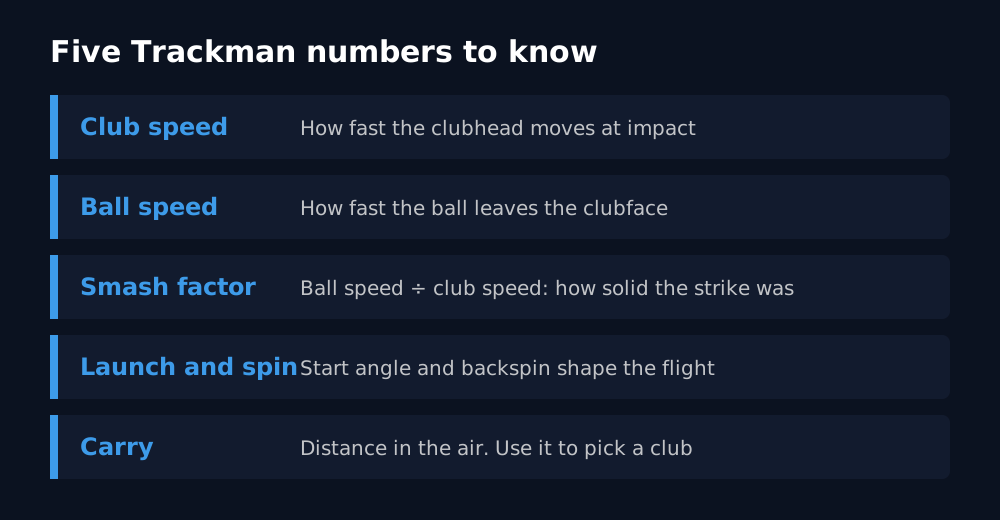
Five numbers to start with
Club speed: how fast the clubhead is moving at impact. More club speed gives you more potential distance.
Ball speed: how fast the ball is moving just after impact.
Smash factor: ball speed divided by club speed. It shows how solidly you struck the ball, and a more centered hit gives a higher number.
Launch angle and spin rate: the angle the ball starts at and how much backspin it has. Together they shape how high the ball flies and how far it carries.
Carry distance: how far the ball travels in the air before it lands, not counting roll. Carry is the number to use when choosing a club.
Numbers that explain direction
Club path: the direction the clubhead is moving at impact, compared with your target line.
Face angle: where the clubface is pointing at impact. It has the biggest influence on where the ball starts.
Face to path: the difference between the two. It is what makes the ball curve, whether that is a slice or a hook.
Attack angle: whether the club is moving up or down as it hits the ball.
How to use the numbers in a practice session
Pick one number to work on, hit ten shots, and watch how it changes. Trying to fix everything at once rarely works. For example, if your ball keeps starting right of the target, watch your face angle. If your drives feel weak, look at club speed and smash factor.
See your own numbers
New and interested members can try a bay with a free hour. Our owners walk you through the club and show you how to use the Trackman software. Learn more about the bays on our Trackman simulator page, or see membership pricing.


Comments